
Leather has long been associated with durability, elegance, craftsmanship, and timeless style. It is commonly used to make wallets, handbags, belts, shoes, jackets, watch straps, furniture, car seats, and many other everyday products. However, not every item that looks like leather is made from real animal hide.
Understanding the difference between genuine vs faux leather is important because both materials can look remarkably similar when they are new.
Modern manufacturing techniques allow faux leather to copy natural grain patterns, surface pores, colour variations, softness, and even the smell of real leather. At the same time, some genuine leather products are heavily coated, polished, or embossed, which can make them look unusually smooth and artificial.
This guide explains the main faux leather vs real leather difference, how to identify genuine leather, how different materials age, and how to check leather quality before buying.
What Is Bonded Leather?
Bonded leather is made by combining leather fibres, scraps, polyurethane, adhesive, and other materials. The mixture is pressed onto a backing and coated to create a leather-like surface.
Although bonded leather contains some real leather, it is not a complete sheet of natural animal hide. It is often used for affordable office chairs, sofas, book covers, belts, and accessories.
Bonded leather may look attractive when new, but the surface can eventually peel, crack, or separate from the backing. Its durability is usually lower than full-grain, top-grain, or solid split leather.
Genuine Leather vs Synthetic Leather
The main genuine leather vs synthetic leather difference begins with the material source. Genuine leather is made from animal hide, while faux leather is created from synthetic coatings and fabric.
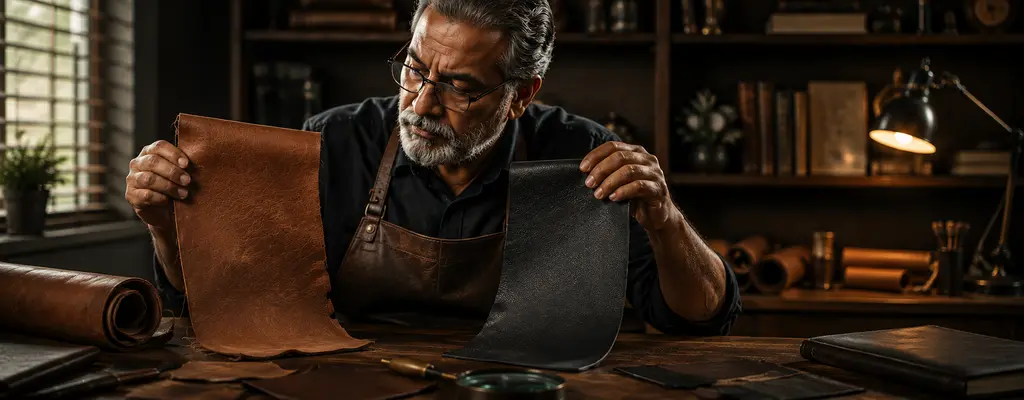
Natural leather usually has an irregular grain pattern. Its pores, wrinkles, scars, and colour may vary across the surface. Faux leather is produced by machines, so its grain pattern often looks more consistent and repetitive.
Genuine leather generally feels warm, flexible, and slightly uneven. Faux leather may feel smoother, cooler, more slippery, or plastic-like.
Real leather is usually more breathable because its natural fibre structure allows some movement of heat and moisture. Synthetic leather is generally less breathable, which can make shoes, jackets, furniture, and car seats feel warmer during prolonged use.
The way the two materials age is also different. Genuine leather can soften, darken, and develop patina. Faux leather usually maintains a consistent appearance for a period of time, but it may eventually fade, crack, peel, or expose its fabric backing.
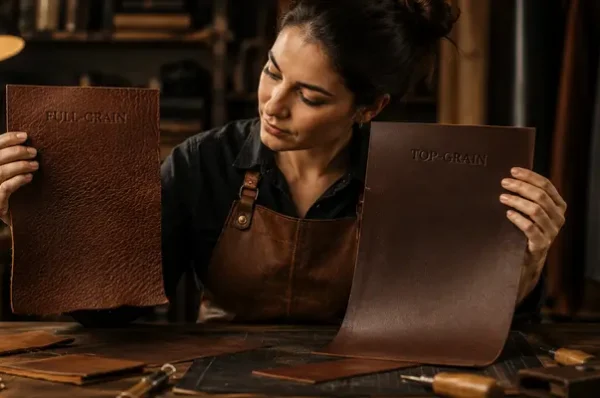
Read also: Full-Grain vs Top-Grain Leather: Understanding the Difference Before Buying
How to Tell Real Leather from Fake by Looking at the Surface?
Examining the surface is one of the first steps in learning how to tell real leather from fake.
Real leather is rarely completely perfect. It may contain small wrinkles, uneven pores, minor scars, grain variations, or slight colour differences. These natural characteristics are created by the animal hide.
Faux leather often has a uniform surface because the grain is embossed by a machine. When examined closely, the same pore shapes or grain lines may repeat across the material.
How Can I Tell If Leather Is Real Just by Touching It?
Touch can provide useful clues when comparing genuine vs faux leather.
Genuine leather often feels slightly warm after being held. Its texture may vary from one section to another because natural hide is not perfectly uniform. It may feel soft, flexible, dense, and slightly textured.
Faux leather often feels smooth, cool, rubbery, or plastic-like. The texture may remain exactly the same across the entire product.
Checking the Back of the Material
The underside of real leather usually has a soft, rough, or suede-like appearance. It may contain visible fibres and feel slightly fuzzy.
The back of synthetic leather often looks like fabric. A woven, knitted, or mesh-like structure may be visible underneath the coating.
This is one of the more reliable leather authenticity tests when the underside is accessible. However, many finished bags, shoes, wallets, and jackets include lining that completely covers the backing material.
Real Leather Smell Test
The real leather smell test is commonly used because natural leather often has a distinctive earthy, warm, woody, or slightly smoky scent.
Faux leather may smell like plastic, vinyl, rubber, glue, or chemicals. A newly manufactured synthetic product may have a particularly noticeable factory smell.
However, genuine leather does not always smell different from faux leather. Some synthetic products are treated with leather-like fragrance, while genuine leather may be heavily coated or stored near perfume, cleaning products, plastic packaging, or smoke.
The smell test should therefore be treated as supporting evidence rather than final proof.
Genuine Leather Durability
Genuine leather durability depends on the grade, thickness, tanning method, surface treatment, stitching, product design, and level of care.
High-quality full-grain leather can last for many years and may even remain usable for decades. Because the surface is part of the natural hide, it does not usually peel in the same way as coated synthetic material.
Real leather may become softer, darker, shinier, and more flexible with age. Scratches and colour changes may gradually blend into the developing patina.
Why Faux Leather Cracks and Peels
Faux leather usually consists of a synthetic surface attached to a fabric backing.
Repeated bending, friction, heat, sunlight, body oils, and moisture can weaken the surface coating. Once the upper layer begins to separate, it may crack or peel.
Cracked leather-like surfaces may reveal the fabric underneath. Once extensive peeling begins, permanent repair is difficult. Paint, patches, or repair compounds may improve the appearance temporarily, but they rarely restore the original material completely.
Faux Leather Pros and Cons
The faux leather pros and cons should be considered according to how the product will be used.
Faux leather is generally more affordable than genuine leather. It is available in many colours, patterns, and finishes. Its surface is usually easy to clean, and minor spills can often be removed with a damp cloth.
It may be a practical option for decorative furniture, occasional-use handbags, fashion accessories, children’s products, and items that are likely to be replaced when trends change.
The main disadvantages are lower breathability, limited repairability, and a shorter average lifespan. Faux leather may also feel uncomfortable in hot weather and may crack or peel after repeated use.
Vegan Leather vs Real Leather
The vegan leather vs real leather comparison often involves ethical, environmental, financial, and practical considerations.
Real leather is produced from animal hide, while vegan leather avoids animal-derived material. This makes faux leather attractive to people who prefer not to use animal products.
However, many vegan leather products are made from PU or PVC. These materials are plastic-based, difficult to recycle, and generally not biodegradable.
Newer eco-friendly leather alternatives may use cactus, pineapple leaves, mushrooms, apples, cork, grape waste, or recycled fibres. However, many of these products still contain polyurethane, polyester, or another synthetic binder.
How to Check Leather Quality Before Buying
Learning how to check leather quality before buying requires more than confirming whether the material is genuine.
A real leather product can still be poorly made if the stitching, lining, hardware, edge finishing, glue, or overall construction is weak.
The stitching should look straight, tight, and evenly spaced. Areas exposed to frequent pressure, such as handles, strap attachments, belt holes, wallet folds, jacket elbows, and shoe bends, should be properly reinforced.
The edges should look clean and carefully finished. Excess glue, uneven cutting, loose layers, or exposed fabric may indicate poor manufacturing.
Zippers, clasps, buckles, buttons, and rivets should feel solid and operate smoothly. Weak hardware can make an otherwise good leather product unusable.
“leather finish,” or “premium leather look” may describe appearance rather than material composition.
Common Mistakes When Buying Leather
One common mistake is assuming that the words “genuine leather” always indicate premium quality. Genuine leather is real, but full-grain and top-grain leather are generally considered higher grades.
Another mistake is relying only on smell. Synthetic materials can be scented, while coated natural leather may have very little noticeable smell.
Price can also be misleading. An expensive product is not automatically genuine, and a low-priced product is not automatically fake. Branding, packaging, import costs, advertising, and seller margin can significantly affect the final price.
Summary
The genuine vs faux leather comparison is not simply a choice between a good material and a bad material. Both options have advantages, disadvantages, and suitable uses.
Genuine leather is valued for its natural texture, breathability, durability, repair potential, and ability to develop patina. Faux leather is valued for its affordability, consistent appearance, easy maintenance, water resistance, and animal-free construction.
To understand how to tell real leather from fake, examine the leather grain texture, pores, edges, backing, flexibility, smell, and material label. Combining several leather authenticity tests provides a more reliable result than depending on only one method.
Before buying, check not only the material but also the stitching, lining, hardware, edge finishing, seller reputation, warranty, and return policy.



Comment (1)